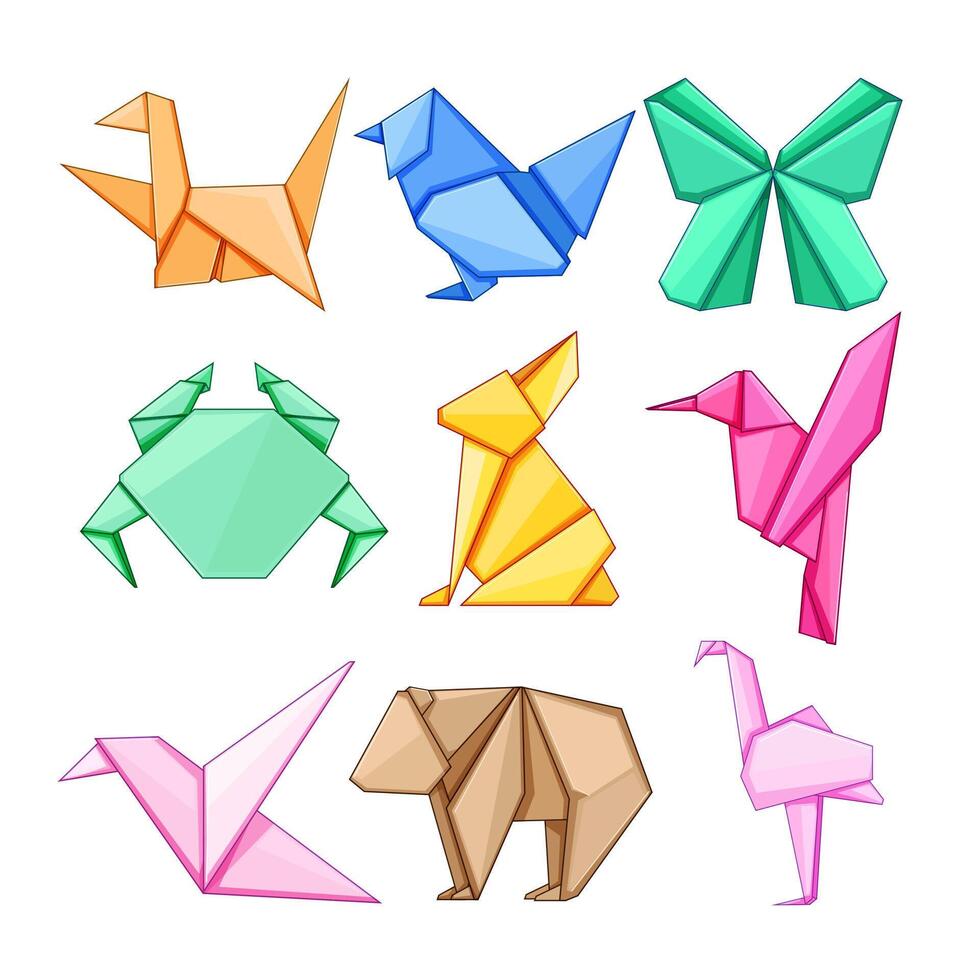
This week, I wanted to focus on how the origami skills and techniques I have learned can be incorporated into the classroom setting. Origami and its foundational skills can be incorporated starting in early primary ages with simple mountain and valley folds to teach students how to effectively fold a piece of paper, and can increase in difficulty as students grow up. I wanted to try out a few different seemingly simple projects to see what I believe might work in an elementary school classroom, and what might be too challenging for students.
Benefits of Origami for Students
Incorporating origami into elementary school classrooms has many benefits for students. Origami.org discusses 10 different ways that origami benefits students aged 7-12. You can read all of the different skills they discuss by clicking the link above, but the three that really stood out to me were:
- Enhancing fine motor skills: Origami requires students to precisely manipulate paper to form different shapes and structures. This is a skill that can be challenging for students, and origami gives them a fun and engaging way to practice this skill. As students pinch, fold, and crease the paper, they are building their skills in dexterity and hand-eye coordination.
- Building patience and concentration: Origami requires students to follow step-by-step instructions that they may find challenging at times. Practicing origami helps them to build their attention span and encourages them to be patient when things do not work out right away.
- Problem solving and critical thinking: Origami encourages students to think critically as they follow instructions, imagine and visualize what the finished project is going to look like, and determine what steps need to be taken to achieve that product. As students encounter challenges throughout their process, they must problem-solve to figure out what went wrong, identify possible solutions, and adjust their approach.
This YouTube video also discusses some of the ways origami can be beneficial for children:
The Projects
Angelfish
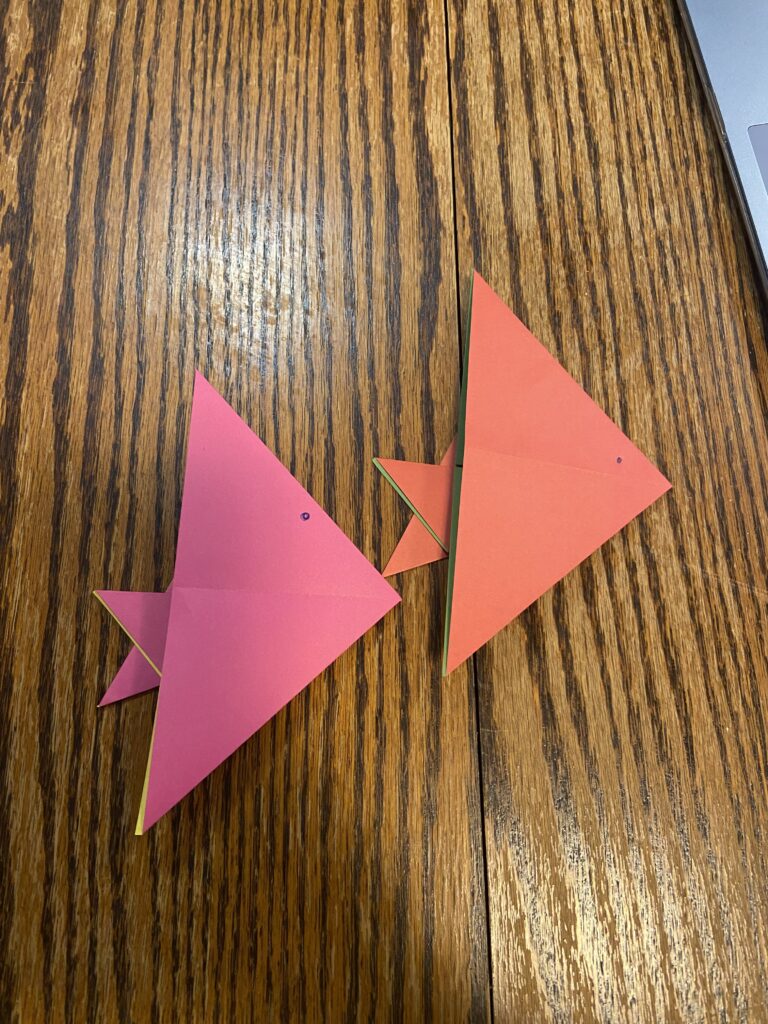
The first project I decided to try was the angelfish. I chose this design because it was simple, and the instructions were clear (here is a link to the pattern I followed). I worked on this project with my friend, who had never done origami before that day. I didn’t want my experience with the craft (however brief) to influence my ideas on how easy or challenging it was. It was definitely helpful to have a second opinion. We both concluded that this project is definitely one that could be brought into an elementary school classroom. The whole design took us only about 5 minutes to complete and follows very simple folding steps; it involves folding the paper into a waterbomb base and an additional two folds after that.
This project would be ideal for an elementary school classroom for students as young as 7 years old. I believe this would be a fantastic introductory project, as the simplistic nature of the design would help build confidence in students. The final product is cute, easy to identify, and would make students feel proud of their work. Additionally, it would help young students develop fine motor skills in a way that would not overwhelm them. Students may need a bit of assistance with this project, particularly if they have not been previously introduced to the foundational folds. However, if the process is modelled to them, step-by-step, I think it would be a fantastic classroom activity. I definitely would try this in my future classroom.
Turtle
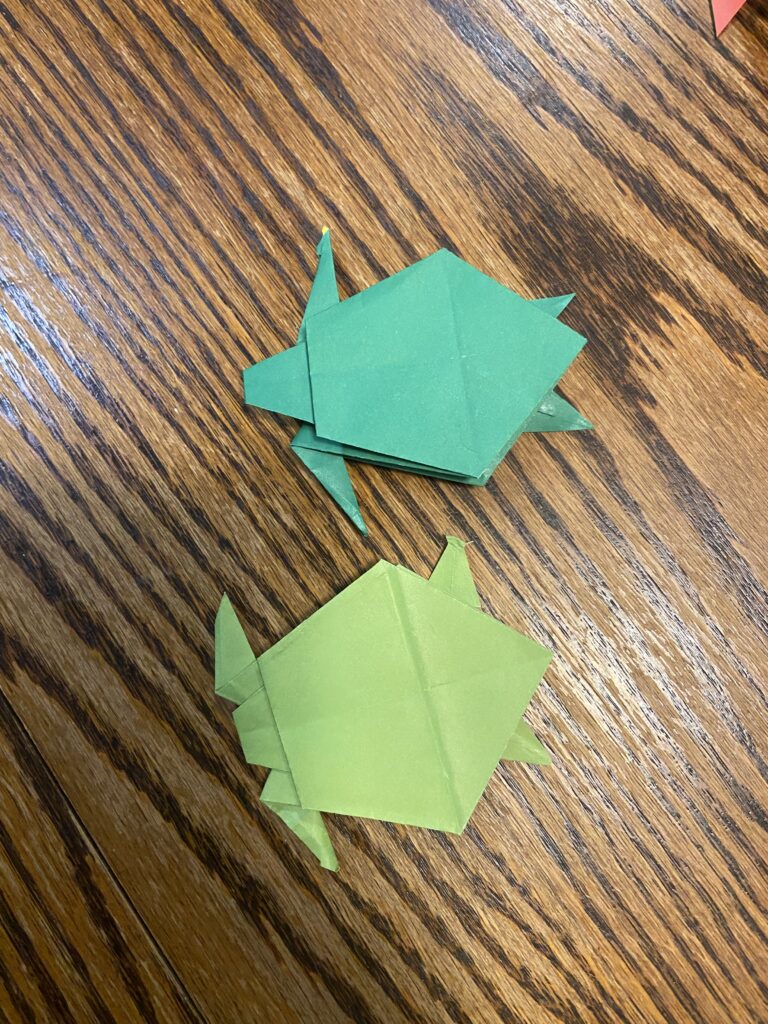
The second project I decided to try was the turtle (here is the pattern that I followed). I chose this design because I wanted to try something that seemed slightly more intricate than the angelfish. Compared to the last project, this one definitely required more attention to detail. The angelfish would still look good even if the folds weren’t 100% accurate; this one required a lot more precision when completing the folds. Throughout my process of completing this design, I found the instructions slightly more challenging to follow at times, and it included the petal fold, which is one of the more challenging folds. I recognized quickly I needed to take my time and be patient so my project would turn out how I wanted it to.
Despite this project being a little bit more challenging than the last one, I do think it would be a beneficial project to bring into the classroom, particularly in the upper intermediate grade levels (5-6). This design could help students work on problem-solving skills, patience, and perseverance when following the steps that are a little bit more challenging. To address the challenges they may face, I would model each step and provide assistance when necessary, as I had to do with my friend who completed the project with me. I would definitely consider implementing this in my future classroom, especially once students have built up some confidence in origami skills.
Elephant Head
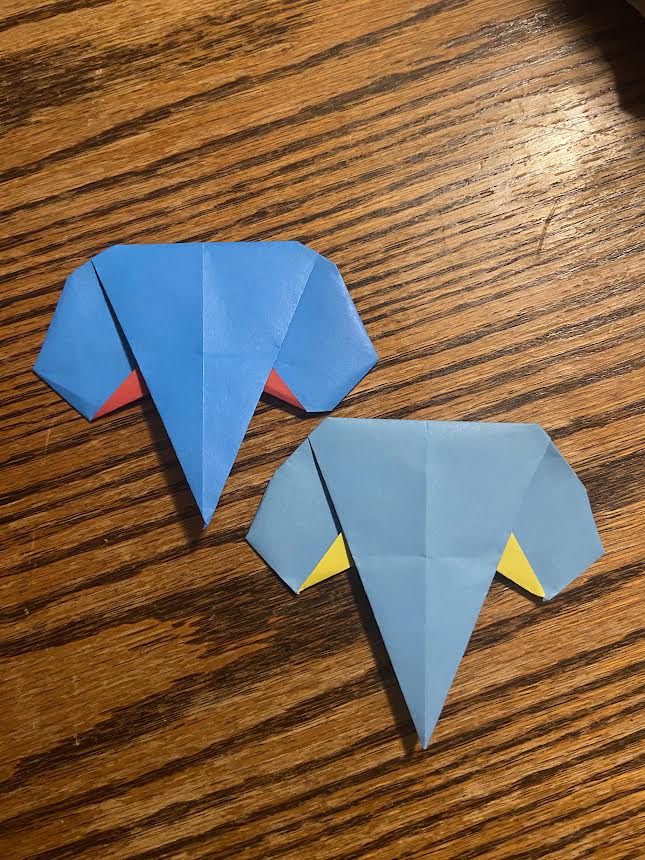
The final project I decided to try was an elephant head (here is a link to the pattern I followed). I decided to try this pattern because I liked the idea of creating an identifiable animal without having to worry about a whole body. I was also curious about the skills it would take to create the features of the elephant, like the ears and the trunk. This project was, similar to the angelfish, straightforward and simple to follow. One thing I did notice is that I paid a lot of attention to exactly which folds were going to create the most identifiable features, and I focused especially on perfecting those. It made me realize how precision is important in creating these features so the finished project is recognizable. I was so happy with the final product; while simpler than the turtle, I think I liked this project more.
This is definitely a project that can be used in an elementary school classroom. I would classify the difficulty level as between the previous two projects. I think this would be perfect for students in the grade 2-3 age range, and it would benefit them in practicing following sequenced instructions and paying attention to details. I also think that students would appreciate the process more, as they can see, through each step, the identifying features of the elephant coming together. I would definitely consider bringing this project into my future classroom.
Origami Cross-Curricular
Origami not only helps students develop skills they will need in daily life, but it can also be used across the curriculum. There are many different subject areas where origami can be implemented into classrooms. Three of my favourite ideas are:
- Science: There are many different ways to implement origami into science classes. The craft involves engineering and design skills that influence scientific discovery in children. My favourite implementation comes from this website, which discusses how the “jumping frog” origami design can help students learn about kinetic energy and observe it visually. Adding a hands-on and creative aspect to science classes may help students be more engaged with concepts they may find challenging in the subject.
- Math: Origami is a recognized art form, but it also contains a lot of components of mathematics. The process involves understanding angles, shapes, and symmetry, and it can create 3D structures (including the cube I made in post #2). It can also be used to explore concepts like fractions (dividing the paper into quarters) in a hands-on and engaging way for students.
- Art: This is the most obvious subject area for implementing origami practices. Origami is a craft and is excellent for artistic expression. It also teaches valuable art skills such as creativity, problem-solving, and fine motor skills (as discussed above). Students can not only fold the paper to create a design, but in a following lesson they can colour, paint, add stickers, or glue things onto their projects to make them customized to their personalities.
Below, I have included a brief YouTube video that shows one example of how origami can be used to teach math concepts!
Now What?
After experimenting with each of these different origami designs, I have gained a better understanding of how I can incorporate origami practices into my future classroom. I have learned so many different ways that origami can benefit students, whether by building and developing critical skills or learning content in different subject areas in a hands-on and engaging way. One of my biggest takeaways from this experience was recognizing the importance of tailoring the designs I bring in to the specific age of the students I am working with. I believe I have developed the skills to recognize what grade an origami pattern would be good for; however, I would like to try these projects with the estimated ages to see if I was correct in my assumptions. I also need to consider that even if I am working with older students, they still may not have had any experience with the craft before and may need to complete a simpler project.
Now, more than ever, I am excited to take the knowledge I have developed through this process and bring it into my future classrooms.
Sorry, but comments are not enabled on this site.